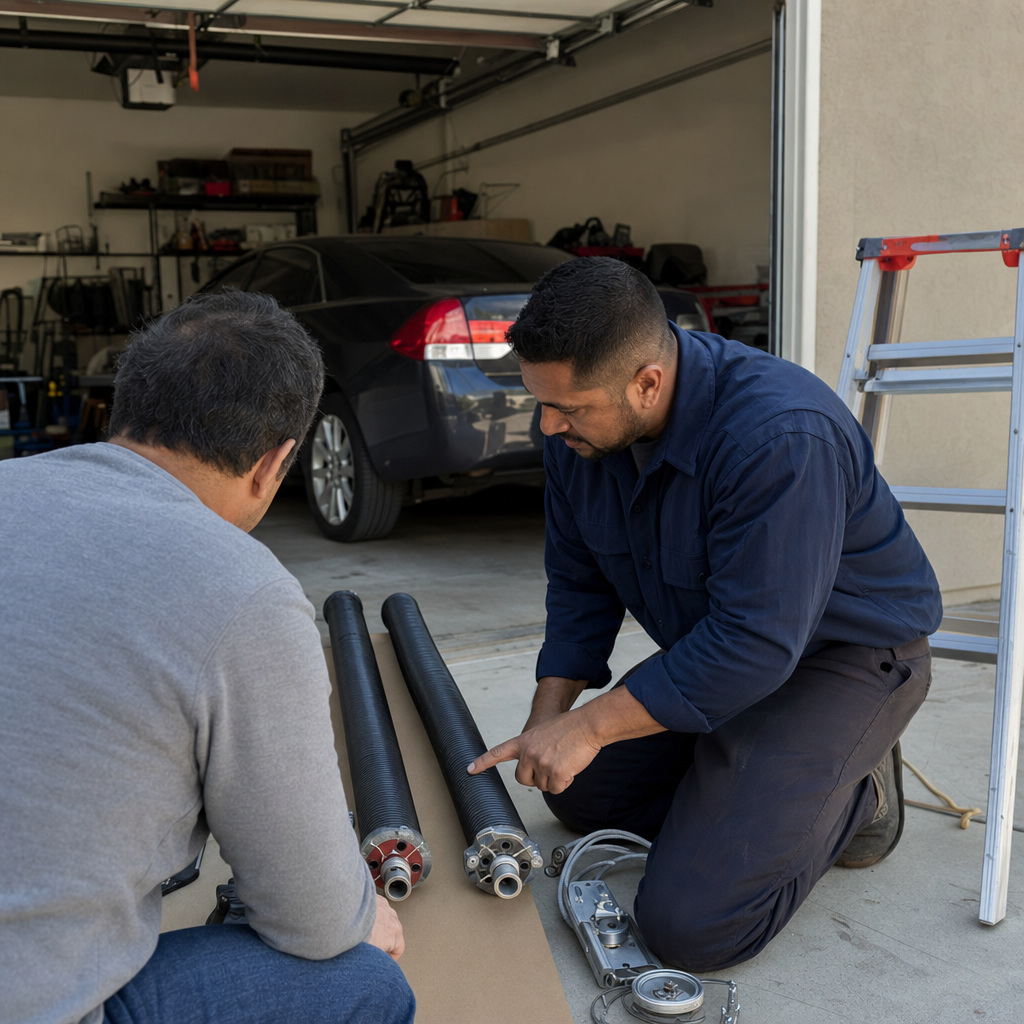
Torsion vs. Extension Springs in Los Angeles: Choose Torsion Unless Your Garage Has Under 7 Inches of Headroom
For most Los Angeles homeowners, torsion springs are the better choice — they last longer, fail more predictably, and in a seismic zone like ours, they don’t become projectiles when a coil lets go. Extension springs remain a practical option only when headroom is genuinely too tight for a standard torsion setup, which does happen in the 1920s–1950s detached garages common to South LA, Mid-Wilshire, and Koreatown. If you’re not sure which system your garage has or whether it’s still up to the job, call us at (844) 747-0953 — Thomas Hernandez will take a look and give you a straight answer.
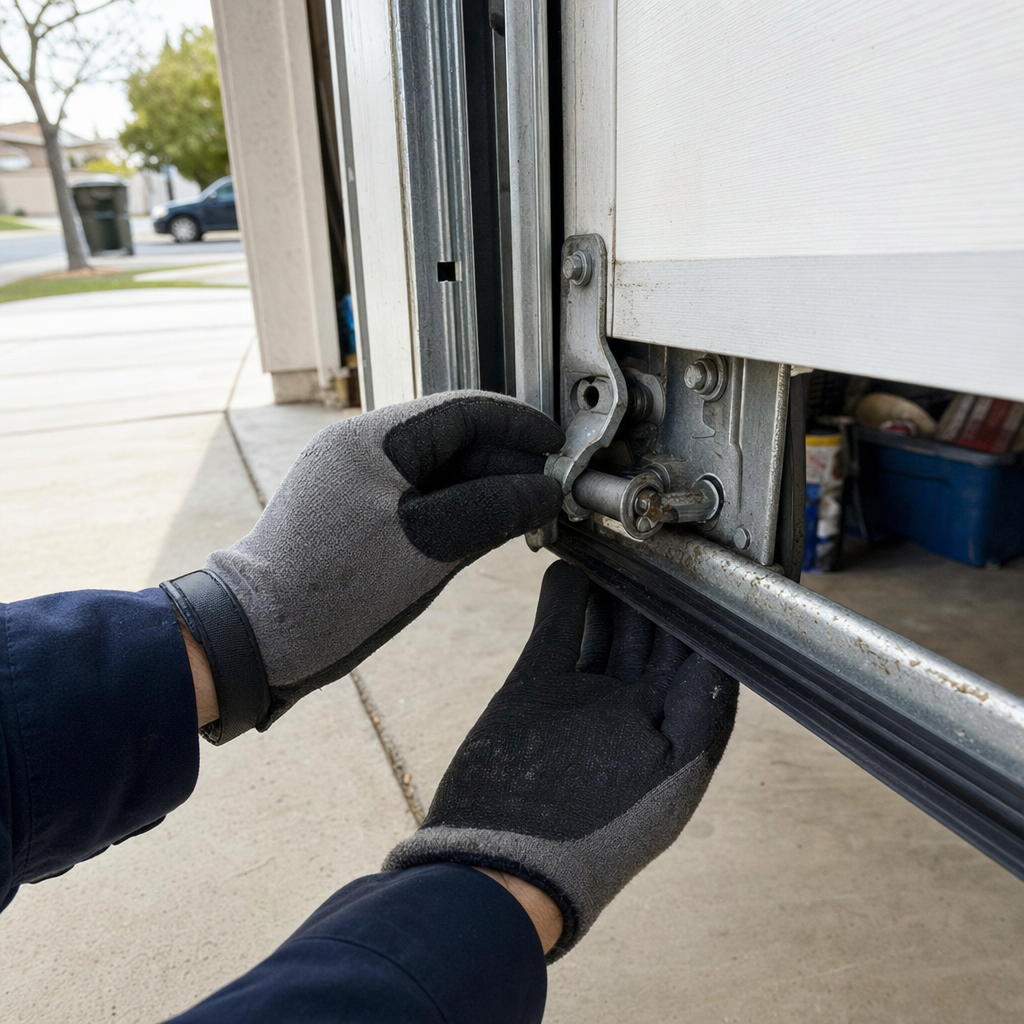
Why the Ground Moving Changes the Torsion vs. Extension Debate in Los Angeles
Every spring comparison article you’ll find online focuses on price and cycle life. Almost none of them acknowledge that Los Angeles is in a high-seismic zone — and that changes the math on spring selection in a specific, concrete way.
Extension springs store mechanical energy along their full length, stretched between the door hardware and a fixed anchor at the back of the track. When a coil fractures or a hook separates — under normal wear, that’s just a loud bang and a stuck door. But in the post-tremor stress environment that older Los Angeles garages experience regularly, the failure mode looks different. A wood-framed bungalow garage in Koreatown or Mid-Wilshire can have its header racked slightly out of square after even a moderate shake. That shifts load unevenly across the two extension springs. One side carries more tension than it should. When it goes, the spring can whip violently along the track or throw a hook across the space — particularly dangerous in the narrow, low-ceiling detached garages that dominate the 90001–90010 ZIP corridor.
The fix is a safety cable threaded through each extension spring — a steel cable that contains the spring if it fractures. California code requires them on new installations, and we add them any time we’re servicing an extension spring setup that’s missing them. But even with safety cables, the underlying physics favor torsion: a torsion spring is wound on a single shaft mounted above the door center. When it fails, it unwinds on that shaft. It stays where it is. In a garage whose walls are already the soft-story weak point in a seismic event, that contained failure matters.
The Headroom Reality in Los Angeles’s Older Bungalow Garages
Here’s where the honest answer gets more specific. Thomas Hernandez has replaced dozens of extension spring systems in detached garages across South LA and the Mid-Wilshire area, and the original reason those garages got extension springs in the first place was headroom — or the lack of it.
A standard torsion spring setup requires roughly 10 to 12 inches of headroom above the door opening. A lot of original 1920s–1940s bungalow garages in Los Angeles were built with 7-foot interior clearance, which leaves 8 inches or less above a standard door — not enough for a conventional torsion tube and hardware. Extension springs, which mount to the horizontal tracks rather than above the door, historically worked in these spaces. That’s why you still find them in so many older alley-access garages across this city.
If your garage falls into this category, you have two real options: stay with extension springs and make sure safety cables are properly installed, or have a low-clearance torsion conversion done using a specially bracketed system designed for tight headroom. We carry the hardware for these conversions. The low-clearance torsion setup costs more upfront than a like-for-like extension spring replacement — spring repair or replacement in the Los Angeles market typically runs $210–$400 — but it solves the seismic risk and usually outlasts an extension spring replacement by several years given LA’s heat-cycling wear patterns.
How LA’s Climate Wears Springs — and Why That Affects Which One Is Easier to Maintain
Los Angeles doesn’t have freeze-thaw cycles. That removes one of the major spring-killer mechanisms you’d worry about in Chicago or Denver. What we do have is intense year-round UV, high summer temperatures, and metal hardware that cycles through significant thermal expansion every single day on sun-facing garages. Spring steel expands and contracts with heat. Over thousands of cycles, that affects tension calibration.
Here’s the practical difference: torsion springs can be re-tensioned incrementally as they relax over time, extending service life without full replacement. Extension springs wear as a matched pair — when one side fatigues, both need replacing, and uneven wear between the two sides is harder to catch before one of them fails. In LA’s climate, where springs wear from heat rather than cold brittleness, we see extension spring failures happen more suddenly and with less warning than torsion spring failures, which tend to give more gradual performance signals first.
The System-Level Reason: Your LiftMaster or Chamberlain Opener Matters Too
Spring type isn’t just a hardware decision — it interacts with your opener. Certain LiftMaster DC-motor models with battery backup are particularly well-suited to torsion spring setups because the torque requirements and door balance assumptions in those systems are calibrated for torsion-balanced doors. After a significant earthquake, battery backup access becomes genuinely important — power outages and blocked exits are real scenarios in Los Angeles. A Chamberlain opener with integrated battery backup paired with a properly tensioned torsion spring gives you the most reliable post-event access from a system standpoint.
California also mandates horizontal seismic bracing kits on new garage door installations in high-seismic zones. Torsion spring systems — with their hardware concentrated above the door header — interact more cleanly with that bracing hardware than extension setups, which have cables, pulleys, and moving parts distributed along the horizontal tracks. In the tight headspace of an older bungalow garage, routing a seismic brace kit around extension spring hardware gets complicated fast. We’ve done it both ways; the torsion route is cleaner and more effective.
If you’re looking for parts to evaluate your current system, our Garage Door Parts in Los Angeles page covers what we stock and source for both spring types, including safety cable kits and low-clearance conversion hardware.
Side-by-Side Comparison: Torsion vs. Extension Springs in Los Angeles
| Factor | Torsion Spring | Extension Spring |
|---|---|---|
| Seismic failure behavior | Fails on shaft, stays contained | Can whip or throw hardware without safety cable |
| Headroom needed | 10–12 in. standard; less with low-clearance bracket | As little as 6–8 in. |
| LA heat-cycle maintenance | Re-tensorable as wear progresses | Must replace both springs as a pair |
| Seismic brace compatibility | Hardware concentrated, cleaner routing | Cables and pulleys complicate brace routing |
| Opener system pairing | Preferred for LiftMaster/Chamberlain battery-backup units | Works, but less optimal for DC-motor openers |
| Typical LA repair cost | $210–$400 | $210–$400 (pair replacement) |
⚠️ A Direct Safety Note on Spring Work
Both torsion and extension springs operate under extreme mechanical tension — enough to cause serious injury or death if handled incorrectly. This is not a job for improvised tools or first-time attempts. Winding torsion springs requires calibrated winding bars and a precise understanding of turn counts for door weight; releasing or replacing extension springs under load without the right technique can result in the spring releasing violently. Thomas Hernandez has 20 years of this work behind him, and he’ll tell you the same thing: spring replacement is one of the few garage door jobs where the cost of a professional is genuinely about keeping yourself in one piece, not just convenience. We keep these Garage Door Parts in stock so jobs don’t wait on shipping — but the installation isn’t the part to DIY.
Key Takeaways
- Choose torsion for most Los Angeles garages — safer seismic failure behavior, easier long-term maintenance in LA’s heat.
- Extension springs are still valid when headroom is genuinely under 8 inches and a low-clearance torsion conversion isn’t feasible — but safety cables are non-negotiable.
- Older detached bungalow garages in Mid-Wilshire, Koreatown, and South LA are the most likely candidates for tight-headroom situations.
- Your opener model matters — LiftMaster and Chamberlain battery-backup systems pair more reliably with torsion setups for post-earthquake access.
- California’s seismic bracing requirement is easier to satisfy cleanly with a torsion spring configuration.
- Spring repair in Los Angeles runs $210–$400 for either system — the system choice affects long-term cost, not necessarily the upfront repair quote.
Frequently Asked Questions
Torsion springs generally outlast extension springs in Los Angeles conditions because they can be re-tensioned incrementally as heat-cycling causes them to relax, rather than requiring full replacement. Extension springs must be replaced as a matched pair once either side shows wear, and in LA’s sun-baked garages, uneven wear between sides can develop before you notice a performance drop. Most quality torsion springs are rated for 10,000–15,000 cycles — more in the right conditions — while extension springs typically run 8,000–10,000 cycles before replacement is advisable. Call (844) 747-0953 if you’d like Thomas to assess how many cycles your current springs have left.
Spring repair or replacement in Los Angeles typically costs $210–$400, whether you’re replacing a torsion spring or a matched pair of extension springs. The wider end of that range reflects low-clearance conversion brackets, heavier commercial-grade springs, or same-day emergency calls. We give you a flat quote before any work starts — no surprises. Call (844) 747-0953 for a free estimate.
Extension springs are safe when properly installed with steel safety cables threaded through each spring — California requires these on new installations, and they’re the critical containment measure if a spring fractures. Without safety cables, an extension spring failure in a seismic zone like Los Angeles can send hardware flying. If your extension springs don’t have safety cables, that’s the first thing to fix regardless of which spring type you eventually choose. We can add them during any service call.
Yes — low-clearance torsion conversion brackets are specifically designed for garages with 8 inches or less of headroom above the door, which is exactly the situation we run into regularly in South LA, Mid-Wilshire, and Koreatown’s original bungalow garages. The conversion costs more than a like-for-like extension spring replacement, but it resolves the seismic risk and simplifies the door’s long-term maintenance. Thomas Hernandez has done these conversions in dozens of LA’s older detached garages and can tell you quickly whether your space qualifies.
If you’d rather have it looked at in person, Titan Garage Door Service Los Angeles offers a no-pressure assessment anywhere in Los Angeles — call (844) 747-0953 and Thomas will take a look, tell you exactly what you have, and give you an honest recommendation. “Twenty years in LA doors. I’ve seen it break every way possible — let’s just fix it right.”
Written by Thomas Hernandez, Owner & Lead Technician at Titan Garage Door Service Los Angeles, serving Los Angeles, CA.