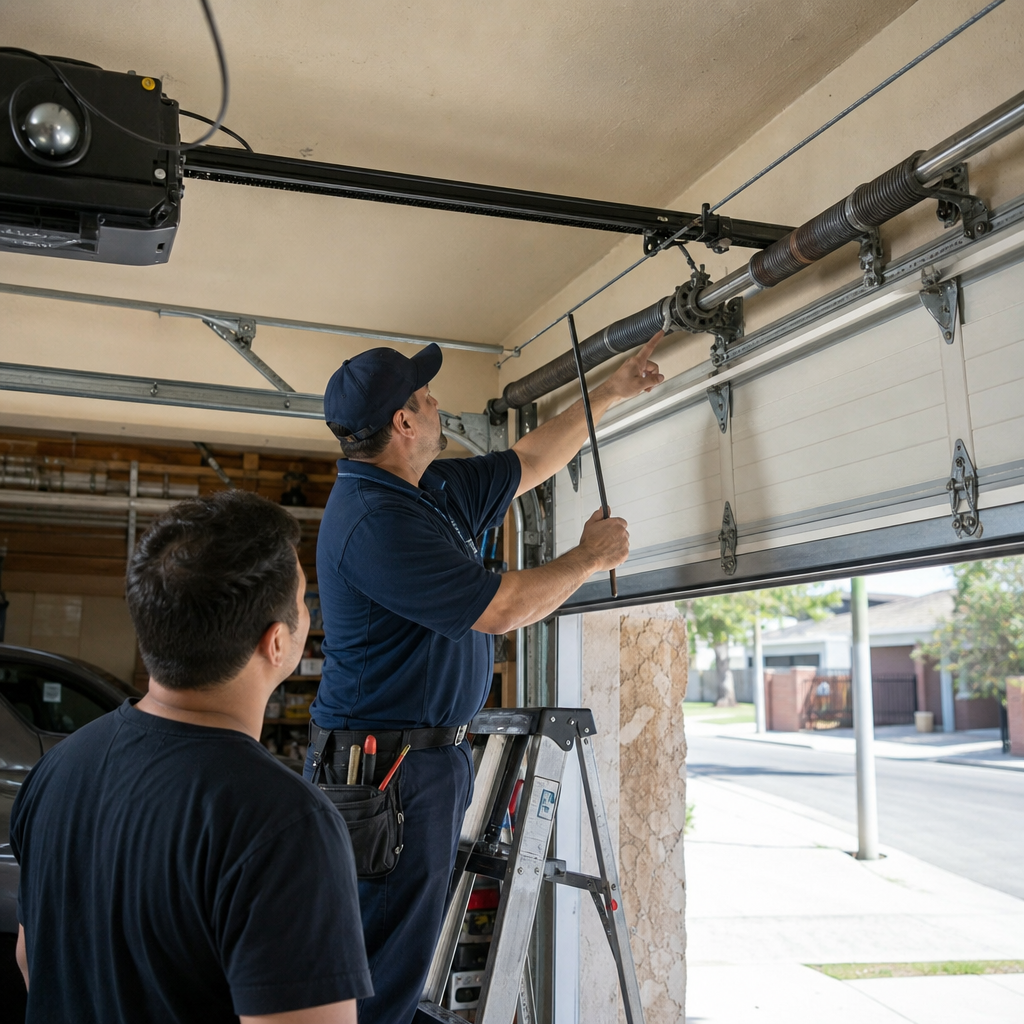
Signs of a Broken Garage Door Spring in Los Angeles, CA
A broken garage door spring usually announces itself in one of three ways: the door drops fast when you release it manually, the opener strains and hums but the door barely moves, or you heard a loud bang from the garage — often described as a firecracker going off — and now nothing works. If any of those happened to you this morning, there’s a strong chance a torsion or extension spring has snapped. Call (844) 747-0953 for a same-day assessment from Thomas Hernandez, Owner & Lead Technician at Titan Garage Door Service Los Angeles.
What a Broken Spring Actually Looks Like — and Why Los Angeles Doors Fail Differently
Thomas Hernandez has been diagnosing spring failures across Los Angeles for 20 years, from alley-facing detached garages in Koreatown to wider two-car setups in Encino. One thing he’ll tell you straight: the signs in LA aren’t always the same as what you’ll read on a generic national site, because the hardware here ages differently.
Most of Los Angeles runs on heat-cycling rather than freeze-thaw. The intense UV index and sun-baked metal mean springs and rollers here wear from thermal expansion and contraction — a torsion spring above a south-facing garage door in the 90055 corridor can cycle through significant temperature swings on a single summer day. That accelerates metal fatigue in a way cold-weather markets rarely see. Add in the aging single-car detached garages throughout South LA and Mid-Wilshire — many fitted with original hardware that hasn’t been touched in two or three decades — and spring failures here are often overdue, not sudden surprises.
Here are the clearest signs your spring has broken or is about to:
- A loud bang from the garage with no apparent cause — torsion springs store enormous tension; when one snaps, it sounds like a gunshot and often leaves a visible gap in the coil.
- The door is very heavy to lift manually — springs counterbalance the door’s weight. Without them, a standard single-car door can feel like 150–200 pounds of dead weight.
- The opener runs but the door barely moves or opens only a few inches — most openers have a built-in load limit; a failed spring throws off the balance and the opener stops itself to avoid burning out.
- The door opens unevenly or one side drops lower than the other — common with extension spring systems, where one spring on a side cable breaks and the remaining spring pulls the door crooked.
- Visible gap in the torsion spring coil — look above the door when it’s closed. A torsion spring with a 1–3 inch separation in the coil has snapped and needs immediate replacement.
- Cables hanging loose or piled on the floor — when a spring breaks, the cables it tensions go slack. You’ll often see them drooping at the bottom corners of the door.
- The door won’t stay open — a healthy spring system holds the door open at any height. A weakened or broken spring lets it drift back down.
If you’re in one of the older bungalow neighborhoods — Watts, Boyle Heights, or the Mid-Wilshire corridor — and your door still has an original tilt-up or an early sectional conversion, the hardware is especially worth a close look. Those spring systems weren’t designed for 2024 opener loads or the UV punishment LA delivers year-round.
⚠️ A Straight Safety Note Before You Do Anything Yourself
Garage door torsion springs are under several hundred pounds of stored tension. A spring that releases unexpectedly can cause serious injury — broken bones, lacerations, or worse. This is not a component to test, adjust, or attempt to replace without proper training and tools. Thomas’s honest advice after 20 years of service calls: look, don’t touch. Confirm the spring is broken visually, disconnect the opener, and call a professional. The repair itself — spring replacement in Los Angeles typically runs $210–$400 depending on spring type, door weight, and whether both springs need replacing — is fast in trained hands and not worth the risk of a DIY attempt gone wrong.
How to Confirm a Broken Spring Before You Call — A Step-by-Step Check
This is a visual inspection only. Do not attempt to operate the door or adjust any hardware.
- Disconnect the opener. Pull the red emergency release cord hanging from the opener trolley to disconnect the door from the drive mechanism.
- Look at the torsion bar above the door. The torsion spring wraps around a steel bar mounted horizontally above the closed door. A broken spring will show a clear gap or separation in the coil — usually 1 to 3 inches wide.
- Check the extension springs if present. Extension springs run parallel to the horizontal tracks on each side. Look for a spring that appears stretched out, detached, or visibly longer on one side than the other.
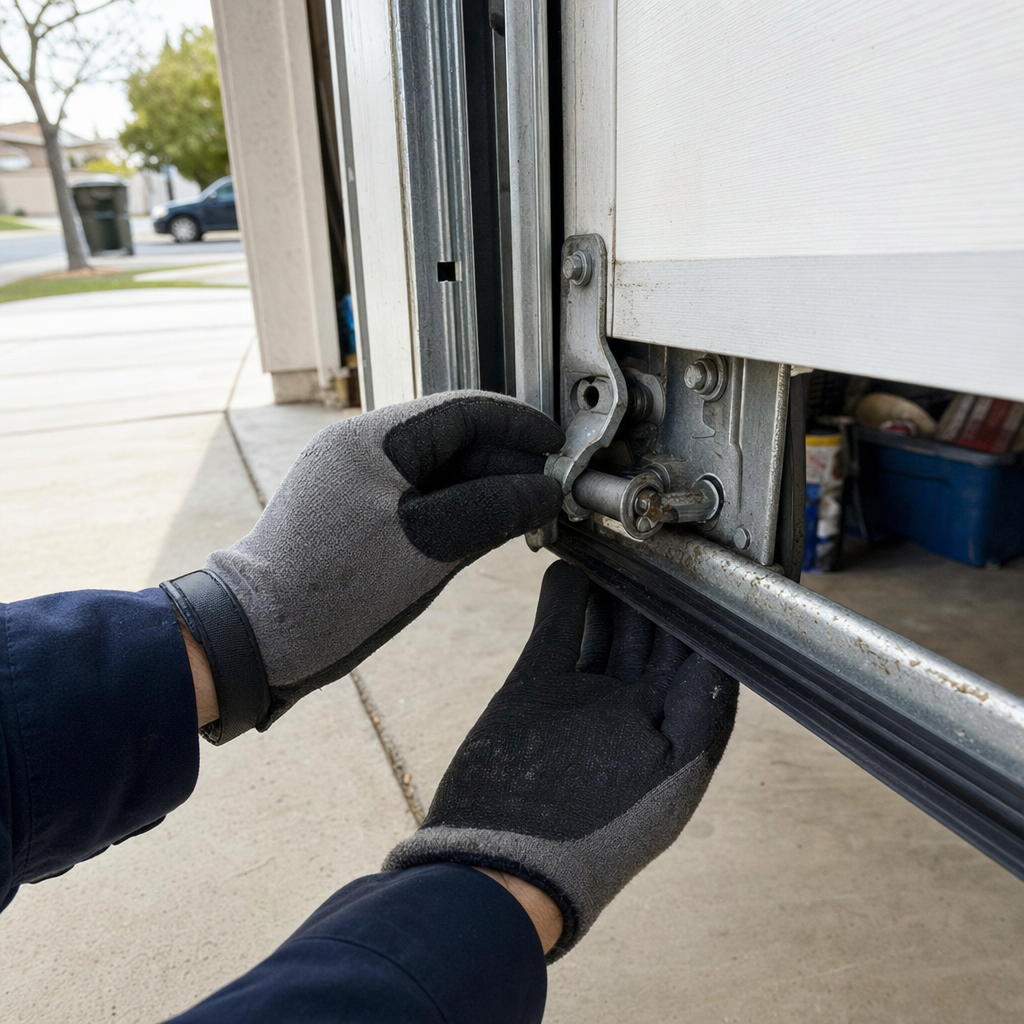
- Inspect the cables at the bottom corners. Lift-cables should be taut when the door is closed. Slack or piled cable is a reliable secondary sign of spring failure.
- Attempt a manual lift — gently, just a few inches. If the door is extremely heavy and doesn’t lift smoothly, the spring system isn’t doing its job. Set it back down and stop.
- Call for service. Once you’ve confirmed the signs, stop operating the door. Running a Genie, LiftMaster, or Chamberlain opener against a broken spring repeatedly can strip the drive and turn a $300 spring job into a $500+ opener repair on top of it.
Need help sourcing the right replacement spring or hardware before a tech arrives? Our Garage Door Parts in Los Angeles page covers what’s typically stocked for the brands we service.
What Spring Repair Costs in Los Angeles — Real Numbers
Spring repair in Los Angeles runs $210–$400 for most residential jobs. Where your cost lands depends on a few variables:
- Torsion vs. extension system — torsion springs are more common on newer installs and cost more to replace; extension springs are often found on older single-car detached garages throughout the ZIP codes we cover (90052, 90053, 90054, 90055).
- Single vs. double replacement — Thomas routinely recommends replacing both torsion springs at once when one breaks. If a spring has failed after years of LA heat-cycling, its partner is close behind. Replacing both in one visit saves a second service call.
- Door weight and size — a heavy Clopay steel door on a two-car opening requires a heavier-duty spring than a narrow 8-foot wood door in an alley-access bungalow. Custom-width doors common in South LA and Koreatown can require non-stock springs, which affects parts cost.
- Cable condition — if the broken spring has also damaged the lift cables, cable repair runs an additional $155–$295. It’s worth having them checked during the same visit.
We stock parts for the brands we service, so there’s no waiting on a third-party supplier for most standard residential springs. “Twenty years in LA doors. I’ve seen it break every way possible — let’s just fix it right.”
For a full overview of what we carry and how we source parts for jobs across Los Angeles, visit our Garage Door Parts page.
Frequently Asked Questions
A broken torsion spring typically makes a single loud bang — similar to a firecracker or a small gunshot — that you can often hear from inside the house. It happens the moment the coil snaps under tension. Many Los Angeles homeowners describe calling us the morning after hearing an unexplained bang from the garage overnight, only to find the door won’t open. If you heard it, that’s almost always the spring. Call (844) 747-0953 for a free assessment.
No — you should not operate the door until the spring is replaced. Running a LiftMaster or Chamberlain opener against a broken spring puts serious strain on the motor and drive, and the door itself is unpredictably heavy without spring tension. In some cases the opener will stop itself automatically; in others, repeated use causes additional damage that raises the total repair cost well beyond the original spring replacement.
Spring repair in Los Angeles typically costs $210–$400, depending on spring type, door size, and whether one or both springs need replacing. If lift-cables were damaged at the same time, add $155–$295 for cable repair. Call (844) 747-0953 for an exact quote — the estimate is free.
Standard torsion springs are rated for roughly 10,000 cycles — one cycle being one open-and-close. At typical residential use that’s seven to ten years, but in Los Angeles the combination of UV exposure and daily heat-cycling on sun-facing metal hardware tends to shorten that lifespan compared to cooler, cloudier markets. Springs on older South LA or Koreatown garages that haven’t been serviced in 15-plus years are frequently overdue and worth inspecting even before a failure occurs.
If you’d rather skip the guesswork and have it looked at today, Titan Garage Door Service Los Angeles offers a no-pressure assessment — call (844) 747-0953 and Thomas Hernandez will take the call and do the work. We service all major brands across Los Angeles and stock parts to get most doors back up the same day.
Written by Thomas Hernandez, Owner & Lead Technician at Titan Garage Door Service Los Angeles, serving Los Angeles, CA.