Garage Door Maintenance Tips for Los Angeles Homes: What the Generic Checklists Get Wrong
The most important garage door maintenance steps for Los Angeles homeowners are UV skin inspection, heat-cycle hardware checks, and a post-earthquake track assessment — in that order. Most national guides lead with rust prevention and freeze-thaw prep, which simply don’t apply here. Follow the LA-specific sequence below and you’ll catch the failures that actually happen in this climate before they strand you with a door that won’t move. If you’d rather have Thomas walk through it in person, call (844) 747-0953 — estimates are free.
Why Standard Maintenance Guides Don’t Work Here
Most maintenance checklists were written for Chicago winters and Georgia humidity. Los Angeles has neither. What it does have is one of the highest year-round UV indexes of any major U.S. city, near-zero freeze-thaw cycles, and seismic activity that silently racks door frames out of square after every felt tremor.
The result: LA garage doors fail in a completely different sequence than doors in other markets. Steel and fiberglass skins chalk and delaminate long before the hardware shows obvious wear. Springs and rollers fatigue from daily heat-cycling of sun-baked metal — not cold-weather brittleness. And in older neighborhoods like South LA, Koreatown, and Mid-Wilshire, where 1920s–1950s bungalows with single-car detached garages are still the norm, original or early-converted hardware is running on borrowed time under modern daily-use demands it was never rated for.
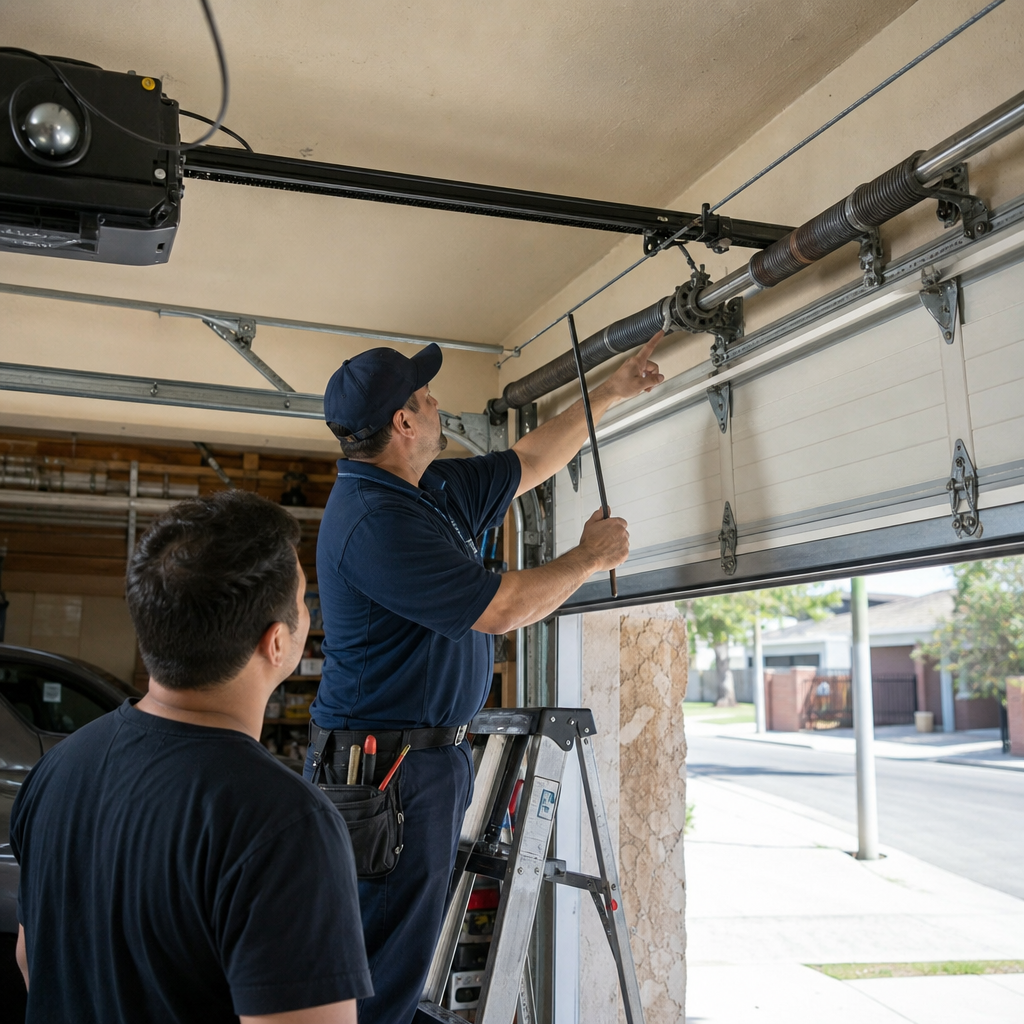
Thomas Hernandez, Owner & Lead Technician at Titan Garage Door Service Los Angeles, picked up his mechanical fundamentals at Los Angeles Trade-Technical College and has spent 20 years fixing doors across every corner of this city — from Boyle Heights bungalows to Encino estates. His take is direct: “Twenty years in LA doors. I’ve seen it break every way possible — let’s just fix it right.” What follows is the maintenance sequence he actually uses.
The LA-Specific Maintenance Checklist (Do These in Order)
Step 1: Inspect the Door Skin for UV Damage Before Anything Else
Run your hand across the painted surface of a steel or fiberglass door on a sunny afternoon. If it comes away with a chalky white residue, UV delamination has already started. Early chalking looks cosmetic. It isn’t. Once the top coating breaks down, moisture works into micro-cracks in the skin — even in a dry climate, morning marine layer is enough — and begins to warp the door’s core from the inside out. A warped panel throws the door out of square, accelerates roller and track wear, and eventually makes the door unadjustable without a panel replacement ($295–$590 in the Los Angeles market).
Catch it early: clean the surface, apply a UV-rated exterior paint rated for metal or fiberglass, and reseal the panel seams. Catch it late and you’re looking at panel or full-door replacement.
Step 2: Check Springs and Rollers for Heat-Cycle Fatigue
LA doesn’t have winters, but metal hardware in direct sun still cycles through a meaningful daily temperature range — often 30–40°F between a pre-dawn low and a mid-afternoon high on a south-facing garage wall. Over years, that daily expansion and contraction grinds down nylon rollers and slowly fatigues torsion springs in a wear pattern distinct from cold-climate failure. The spring doesn’t snap dramatically from one freeze — it develops micro-fractures quietly and fails on an ordinary Tuesday.
What to listen for: a grinding or scraping sound on the way up (worn nylon rollers, typically $130–$260 to replace), a loud pop or sudden refusal to open (spring failure, typically $210–$400 in Los Angeles), or visible fraying on the lift cables ($155–$295 to repair). Look, don’t touch — torsion springs are under significant tension and attempting a DIY repair is genuinely dangerous. This is a job for a trained technician, every time.
On Wayne Dalton and Craftsman doors — two brands we service regularly across Los Angeles — we stock replacement rollers and springs on the truck, which means we’re not waiting on a parts order when we find worn hardware on a maintenance visit.
Step 3: Do a Post-Earthquake Track Check After Every Felt Tremor
This one almost never appears on a national maintenance guide, but it’s routine in Los Angeles. The garage door opening is the classic soft-story weak point in wood-framed construction. Even a moderate tremor can rack a wood door header subtly out of square — not enough to notice by eye, but enough to force the door to bind in the track, accelerate roller wear, and fatigue hardware for months before anything visibly fails.
After any earthquake you actually felt: stand in front of the closed door and sight down each vertical track from the top. They should be plumb and parallel. Check the gap between the door top panel and the header — it should be consistent across the full width. If one corner has pulled away or the door feels stiff on one side, a track realignment ($140–$285) and possibly a header assessment is the right next call. California also mandates horizontal seismic bracing kits on new garage door installations in high-seismic zones — something a technician working in Los Angeles needs to know cold, and one we handle routinely.
Step 4: Inspect Hinges and Hardware on Pre-1960 Detached Garages Every 6 Months
In the 90001–90010 ZIP corridor — South LA, Watts, Koreatown, Mid-Wilshire — a large share of homes sit on 1920s–1950s-era lots with single-car detached garages accessed from rear alleys. Many retain original tilt-up wood doors or early sectional conversions. The hardware on these doors was never engineered for the daily cycle counts a modern household puts on a door. Six times a day, 365 days a year, adds up to wear rates those hinges simply weren’t rated for.
Every six months — not annually — check the hinge plates for cracks and elongated screw holes, run your fingers across roller stems for wobble, and look at the bottom bracket attachment points where the lift cable meets the door. Alley-access garages in these neighborhoods also face a specific clearance reality: the door swings or tracks into a 10-to-12-foot city alley shared with utility trucks and trash collection. A door that’s drifted even slightly out of square can catch on a vehicle mirror or the alley edge. Small problem in a front driveway. Bigger problem when a trash truck is six feet away.
Step 5: Lubricate Selectively — Not Generously
Over-lubrication is one of the most common mistakes we see in Los Angeles, partly because generic guides recommend it and partly because dry-climate homeowners assume more is better. The reality: excess lubricant on nylon rollers or plastic-coated hardware collects LA’s year-round grit and dust, forming a grinding paste that accelerates wear rather than reducing it.
Use a silicone-based or lithium-grease spray, applied sparingly, to these points only:
- Torsion spring coils (wipe excess immediately)
- Hinges at pivot points
- Roller stems where they meet the hinge bracket
- The curved section of the track — not the straight vertical section
- Lock bar and lock bar guides
Do not lubricate nylon rollers directly, the chain or belt on your LiftMaster or Raynor opener (use manufacturer-approved chain lube only, sparingly), or the rubber bottom seal.
For more on keeping your system running between service visits, the Titan Garage Door Service Los Angeles home page covers the full range of services we offer across the area.
What a Real Maintenance Visit Catches That a DIY Check Misses
A visual walk-around catches obvious problems. A hands-on maintenance visit from someone who has worked on thousands of LA doors catches what’s about to become a problem — the cable with three frayed strands, the roller stem showing lateral play, the spring that’s lost measurable coil tension. Those findings during a routine visit are a $130–$260 repair. The same findings at 10 p.m. when the door won’t close before you leave for a trip are an emergency call and a compromised home until morning.
Thomas takes the call and does the work — not a dispatcher routing a subcontractor. That matters on a maintenance visit because the diagnosis is only as good as the experience behind it. With 20 years across every major brand and 113 verified reviews averaging 4.7 stars in Los Angeles, the visit isn’t a checklist exercise — it’s a set of trained eyes that have seen the specific ways these doors fail in this climate.
Garage Door Maintenance FAQs for Los Angeles Homeowners
Most Los Angeles homeowners should schedule a professional maintenance check once a year, with one exception: if your garage is a pre-1960 detached structure in South LA, Koreatown, or Mid-Wilshire, every six months is the right interval because older hardware wears faster under modern daily use. After any felt earthquake, do a visual track and header check regardless of your normal schedule. Call (844) 747-0953 to set up a free assessment — no pressure, just a diagnosis.
UV-driven skin delamination and heat-cycle spring fatigue are the two failure modes we see most often in Los Angeles that national guides consistently underemphasize. Rust and freeze-thaw damage — the problems most checklists lead with — are almost nonexistent here. A door that looks fine from the street but has chalky panels is often six to eighteen months away from a warped core that no adjustment will fix.
You can apply silicone spray to the exterior of torsion spring coils carefully, but do not attempt to adjust, replace, or remove garage door springs yourself — they store enough mechanical energy to cause serious injury if released suddenly. Any spring work beyond surface lubrication should be handled by a trained technician. Spring repair in Los Angeles typically runs $210–$400 depending on spring type and door size. Call (844) 747-0953 for an exact quote.
Yes — a racked door header after a tremor often shows no obvious visual damage but causes the door to bind slightly in the track, accelerating roller and hardware wear for months before a visible failure. In Los Angeles, where wood-framed bungalow garages are common throughout the older ZIP codes, post-quake track realignment is a recurring service call we handle regularly. Track realignment runs $140–$285 in this market. If your door felt fine before a tremor and slightly stiff after, that’s the check to make.
Ready to Get Your LA Garage Door on a Real Maintenance Schedule?
If anything in this guide flagged a concern — or if your door is just overdue for a proper look — Titan Garage Door Service Los Angeles is a straightforward call away. Thomas will come out, give you an honest assessment, and tell you exactly what the door needs (and what it doesn’t). Call (844) 747-0953 for a free estimate. No upsell, no runaround.
Written by Thomas Hernandez, Owner & Lead Technician at Titan Garage Door Service Los Angeles, serving Los Angeles, CA.