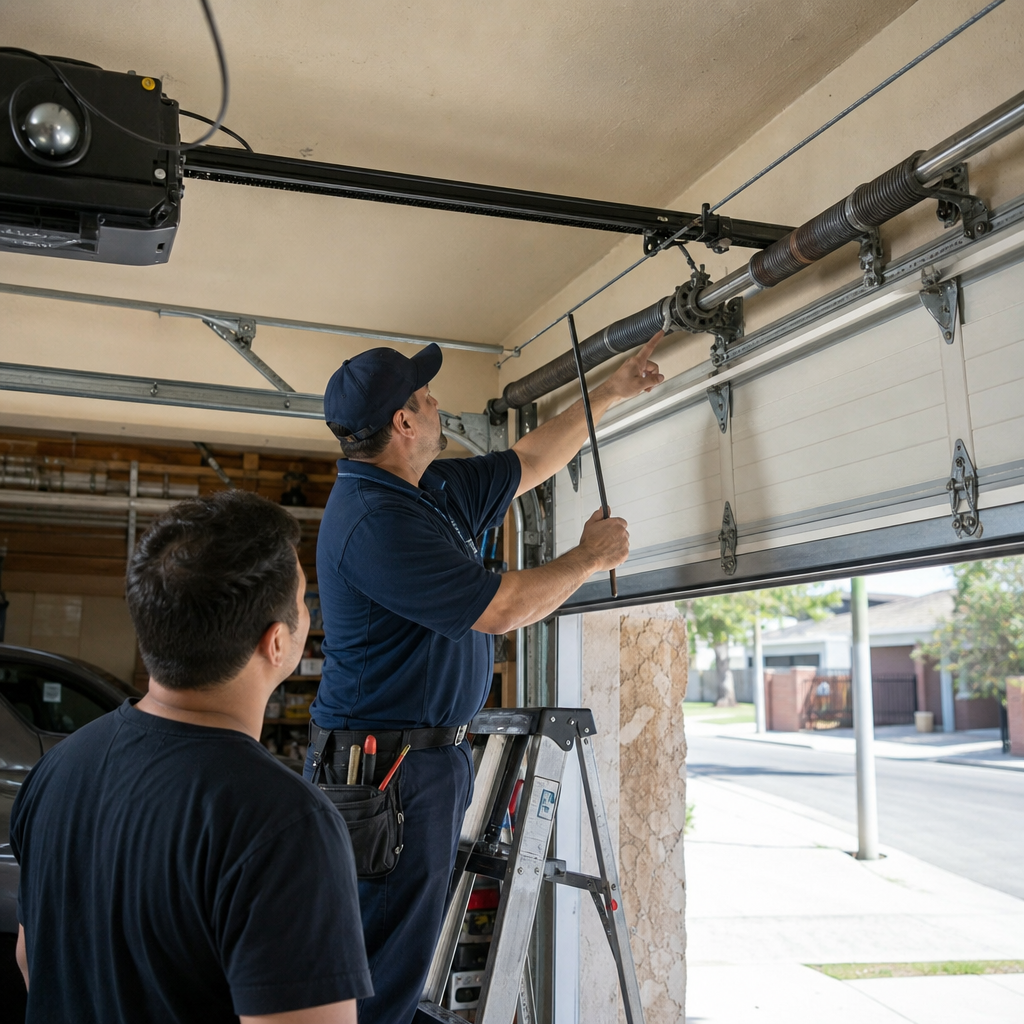
How to Program a Garage Door Opener in Los Angeles — A Step-by-Step Guide That Actually Works Here
To program most garage door openers, press and hold the “Learn” button on the motor head until the indicator light activates, then press your remote button once and wait for the light to blink — confirming the code is stored. That’s the core sequence. But in Los Angeles, where a huge share of homes in neighborhoods like Koreatown and South LA run older Craftsman or Wayne Dalton units on worn wiring that’s never been touched in 20-odd years, the process has a few wrinkles worth knowing before you climb that ladder. If you hit a wall at any step, call us at (844) 747-0953 — estimates are free.

Why Programming a Garage Door Opener in Los Angeles Is Sometimes More Than a 60-Second Job
Most of the programming guides online assume you’re working with a recent opener in a clean suburban garage. A big portion of Los Angeles doesn’t look like that. Thomas Hernandez, our owner and lead technician, grew up in the San Fernando Valley and has spent 20 years running service calls from Boyle Heights bungalows to Encino estates. He’ll tell you the same thing he tells customers on the job: the garage is usually the last thing a homeowner maintains, which means by the time someone’s trying to program a new remote, the underlying system has a few surprises waiting.
In the 90063–90066 ZIP corridor — covering areas like East LA, Palms, and Eagle Rock — detached single-car garages accessed through rear alleys are common. These garages often have openers mounted off-center or close to the ceiling to clear the narrow 8-to-9-foot opening, which means the Learn button is sometimes awkward to reach and the antenna wire (the one that hangs down from the motor) may have been tucked or rerouted over the years. A misrouted antenna is one of the most common reasons a remote won’t program even when you’re doing everything right.
Los Angeles’s year-round UV intensity also does quiet damage. The intense sun chalks and degrades plastic motor housings and circuit boards faster here than in most other U.S. markets. An opener that looks functional can have a receiver board that’s borderline — it accepts one programming attempt and then drops the code an hour later. That’s not user error; that’s a board that needs replacing.
Step-by-Step: How to Program Your Garage Door Opener Remote
The steps below cover the most common residential systems. Craftsman, Wayne Dalton, and Raynor units sold in the Los Angeles market over the past two decades all follow a Learn-button sequence, though the button color and location vary by model and year. Work through these in order.
- Locate the Learn button. It’s on the back or side of the motor unit — the box mounted near the ceiling. The button is typically yellow, red, orange, green, or purple depending on the brand and model year. Older units sometimes have a dip-switch panel instead of a Learn button; if that’s what you see, skip to the FAQ below.
- Check the antenna wire. A short wire hangs down from the motor housing. Make sure it’s hanging freely and isn’t coiled, pinched against a beam, or tucked up into the housing. In alley-access garages, installers sometimes shorten or reroute this wire to clear traffic lines — that kills reception range.
- Clear old codes if needed. If you’re starting fresh or the remote won’t sync, hold the Learn button for 6–10 seconds until the indicator light goes out. This wipes all stored remotes. You’ll need to reprogram every remote and keypad after this step.
- Enter programming mode. Press and release the Learn button once. The indicator light will turn on and stay on. You have approximately 30 seconds to complete the next step before it times out.
- Program the remote. Point the remote at the motor unit and press the button you want to use. Hold it for 3 seconds, then release. The motor unit’s light should blink, or you may hear two clicks — either confirms the remote has been accepted.
- Test it. Press the programmed button. The door should move. If it doesn’t, repeat from Step 4 — sometimes a weak battery in the remote causes a failed first attempt.
- Program a keypad (if applicable). Enter your chosen PIN on the keypad, then press and hold the Enter key while the opener is still in Learn mode. The lights will blink to confirm.
For Garage Door Opener in Los Angeles installations or full replacements, we walk every customer through this process on-site so there’s no guesswork after we leave.
When the Programming Steps Work But the Door Still Won’t Move
This is where Thomas has seen homeowners spend an hour troubleshooting what turns out to be a different problem entirely. If the opener accepts the remote (the light blinks, the signal confirms) but the door doesn’t respond, you’re looking at a mechanical or electrical issue — not a programming failure.
Common culprits in Los Angeles homes:
- Disconnected trolley carriage. The red emergency cord gets pulled during power outages (common after seismic events) and the carriage doesn’t re-engage automatically on all models. The motor runs but the door doesn’t move.
- Misaligned safety sensors. The two small sensors at the bottom of the door tracks must face each other exactly. In older garages, a minor foundation shift — not unusual in LA’s seismic zone — can knock them out of alignment. A solid amber light on one sensor means they’re misaligned.
- Worn drive gear. On high-use openers, the drive gear inside the motor unit strips over time. You’ll hear the motor run but the chain or belt won’t engage.
- Degraded logic board. As noted above, LA’s UV and heat cycling ages circuit boards faster than in cooler climates. Opener repair in Los Angeles runs $140–$380 depending on whether it’s a board swap, gear replacement, or full unit replacement.
If your door isn’t moving after a successful programming sequence, that’s the point to call a technician rather than keep troubleshooting blind. Visit our main Garage Door Opener service page for more on what a full opener diagnostic covers.
Dip-Switch Openers: What to Do With Older Units
Some homes in South LA and Koreatown still have openers from the 1980s and early 1990s that predate the Learn-button era entirely. These use a row of small dip switches — typically 8 or 12 in a row — inside both the motor unit and the remote. Programming means matching the switch positions exactly between the two. It works, but replacement remotes for these units are increasingly hard to source, and the security protocol (fixed codes) is considered outdated. If you’re on a dip-switch system and your remote finally dies, it’s often more practical to replace the opener than hunt down a compatible remote.
Opener installation in Los Angeles runs $295–$650 for a standard residential unit, including the labor to transfer your existing hardware where possible. “Twenty years in LA doors. I’ve seen it break every way possible — let’s just fix it right.”
Frequently Asked Questions About Programming Garage Door Openers in Los Angeles
If your opener was manufactured after 1993, it almost certainly has a Learn button — check the back or side panel of the motor unit for a small colored button with an LED indicator next to it. Openers from the 1980s and early 1990s typically have a small panel with a row of toggle switches inside the motor housing cover. If you’re unsure of your unit’s age, the model number on the side of the motor housing will confirm it. Call us at (844) 747-0953 and we can identify the unit over the phone.
A remote that repeatedly drops its programming — especially in Los Angeles — usually points to a failing logic board or receiver in the motor unit, not the remote itself. LA’s intense heat and UV exposure degrades circuit boards faster than in most other climates. A new battery in the remote won’t fix a degraded receiver. Opener repair runs $140–$380 in this market; call (844) 747-0953 for a free assessment.
Universal remotes work with most openers made after 1993 that use rolling-code or fixed-code technology, including Craftsman, Wayne Dalton, and Raynor units common in Los Angeles. They won’t work with the oldest dip-switch systems without matching the switch configuration manually. Check the universal remote’s compatibility list against your opener’s model number before purchasing — most list supported brands and frequency ranges clearly on the packaging.
No — modern openers store remote codes in non-volatile memory that survives power loss, so your remotes should work normally once power is restored. What often needs attention after an outage is the trolley carriage: if someone pulled the red emergency release cord during the outage, you’ll need to manually re-engage the carriage before the opener can move the door again. Pull the cord toward the door (not straight down) until it clicks back into the track. If it still won’t engage, call us at (844) 747-0953.
Ready to Have It Sorted Out Today?
If you’ve worked through these steps and the opener still isn’t cooperating, Titan Garage Door Service Los Angeles will send Thomas out to diagnose it directly — no phone queue, no subcontractors. Call (844) 747-0953 for a no-pressure, no-obligation assessment in Los Angeles. We stock parts for the brands we service, so most jobs close same day.
Written by Thomas Hernandez, Owner & Lead Technician at Titan Garage Door Service Los Angeles, serving Los Angeles, CA.