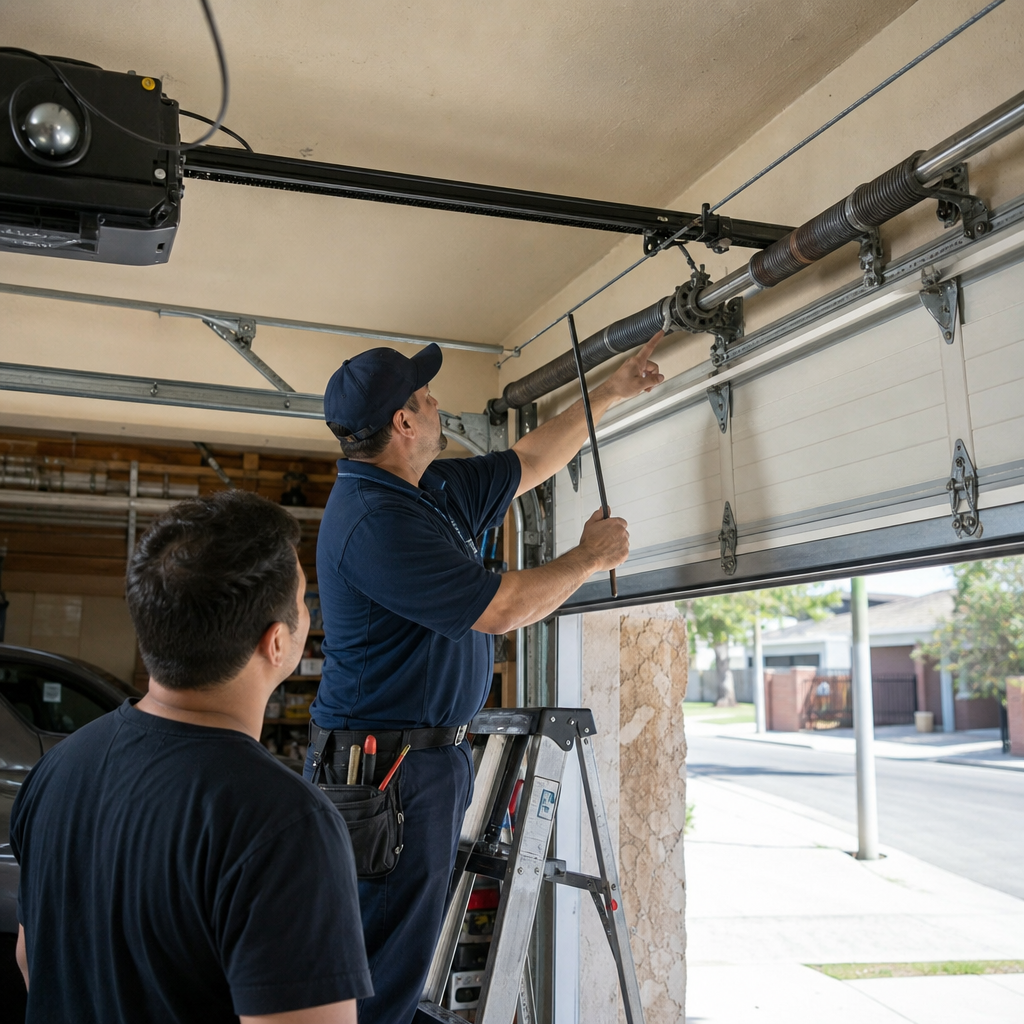
Why Your Garage Door Won’t Close in Los Angeles — and How to Fix It Fast
A garage door that stops mid-travel or refuses to close at all usually comes down to one of four things: misaligned safety sensors, a broken torsion spring, a damaged track, or an opener that’s lost its signal. Most of these are same-day fixes. If you’d rather skip the troubleshooting and get it handled now, call Thomas Hernandez directly at (844) 747-0953 — he takes the call and does the work.

Why Los Angeles Homes See This Problem More Than Most
Los Angeles throws a specific combination of stressors at garage doors that you won’t find in most other markets. The UV index here is punishing year-round — painted steel tracks and hardware bake in the sun until the metal expands and contracts on a daily cycle, grinding rollers and warping tracks in ways that cold-climate wear simply doesn’t replicate. By the time a door in the 90036 or 90037 ZIP codes starts hesitating on the way down, that hardware has often been heat-cycling for years without a single adjustment.
Then there’s the seismic reality. Los Angeles sits on an active fault system, and even moderate shaking can rack a wood-framed door header just enough to pull a track out of plumb. We see this constantly in the older bungalow stock across South LA and Mid-Wilshire — homes with original or early-converted single-car garages where the framing hasn’t been touched since the Eisenhower administration. A door that was closing fine on Monday morning and won’t latch on Tuesday afternoon is sometimes telling you the opener didn’t fail — the opening itself shifted.
California also mandates horizontal seismic bracing kits on new garage door installations in high-seismic zones. That’s a code layer most technicians in other states never encounter. When Thomas is working in Los Angeles neighborhoods like Koreatown or the Mid-Wilshire corridor, that requirement is part of every new install conversation — not an afterthought.
What to Look For Before You Call: A Comparison-Style Checklist
Not every “door won’t close” situation is the same, and the fix ranges from a two-minute sensor wipe to a full track replacement. Here’s how to read what your door is telling you:
- Door reverses immediately after touching the floor: The close-force limit on the opener is set too light, or the floor sensor is reading an obstruction that isn’t there. Common on aging LiftMaster and Chamberlain units.
- Door descends partway, then reverses: Classic safety sensor symptom — one eye is out of alignment or the lens is dirty. Check for a blinking amber light on the sensor bracket.
- Door moves unevenly or jerks on the way down: Worn rollers or a bent track section. In alley-access garages in South LA and Koreatown, we regularly see this caused by a trash truck clipping the door or alley wall over time.
- Door makes a loud pop and drops fast, then won’t move: A torsion spring has broken. Do not attempt to operate the door manually — a door under unbalanced spring tension can fall suddenly and cause serious injury. This is a call-a-professional situation.
- Opener hums but door doesn’t move: Stripped drive gear inside the opener, or the spring has broken and the motor is straining against dead weight.
- Remote works, wall button doesn’t (or vice versa): Wiring or logic board issue rather than a mechanical problem.
That last distinction matters because it changes the repair path entirely. A sensor alignment takes fifteen minutes. A snapped torsion spring on a 9-foot door — the narrow opening size common in older Los Angeles detached garages — is a different job with different parts. Twenty years in LA doors means Thomas has seen it break every way possible — let’s just fix it right.
What Repairs Typically Cost in the Los Angeles Market
Pricing in Los Angeles reflects local labor rates and the real-world complexity of older housing stock. Here’s a honest snapshot of what you’re likely looking at for the most common causes of a door that won’t close:
| Repair Type | Typical Range (Los Angeles) |
|---|---|
| Safety Sensor Realignment / Repair | Included in service call / minor adjustment |
| Track Realignment | $140–$285 |
| Roller Replacement | $130–$260 |
| Cable Repair | $155–$295 |
| Spring Repair (Torsion or Extension) | $210–$400 |
| Opener Repair | $140–$380 |
| Opener Replacement | $295–$650 installed |
| Full Garage Door Repair (multiple issues) | $175–$710 |
Those ranges reflect the actual spread we see across Los Angeles — a straightforward roller swap on a Genie opener system in 90034 is a different ticket than a track rebuild plus spring replacement on a two-decade-old door in 90035. Titan stocks parts for every major brand we service, so we’re not waiting on a supplier to ship before we can finish the job. For Garage Door Repair in Los Angeles across a broader range of issues, that page has more detail on what affects final cost.
Step-by-Step: How to Check Your Safety Sensors Before Calling
Safety sensors cause a significant percentage of “won’t close” calls in Los Angeles. Before scheduling a visit, run through these steps — you might resolve it yourself in under five minutes:
- Look at both sensor lights. One sensor (usually the sending unit) should show a steady green or amber light. The other (receiver) should be solid, not blinking. A blinking light means misalignment or obstruction.
- Clear the sensor path. Check for a cardboard box, a bike, or even a spider web across the beam. Los Angeles garages in older alleys accumulate debris faster than you’d think.
- Wipe the sensor lenses. A damp cloth handles dust and UV-bleached residue that builds up on outdoor-facing sensors. This alone fixes the problem more often than you’d expect.
- Loosen and re-aim each sensor bracket. Most sensors are mounted on wing nuts that allow manual adjustment. Aim both eyes at each other until both indicator lights go solid.
- Test the close function. If the door closes cleanly, you’re done. If it still reverses, the sensor may need replacement — or the problem is mechanical, not optical.
If you get through those steps and the door still won’t close, the issue is somewhere else in the system. That’s where a hands-on look from someone familiar with how Los Angeles housing stock actually ages pays off. A quick call to (844) 747-0953 gets you a straight answer on what it’ll take.
For a broader look at repair options, our Garage Door Repair guide covers the full diagnostic process from opener to hardware.
FAQs: Garage Door Won’t Close in Los Angeles
A door that reverses mid-travel is almost always responding to either a safety sensor signal or a close-force limit that’s set too sensitive. Check that both sensor lenses are clean, both indicator lights are solid (not blinking), and that nothing is crossing the beam path at floor level. If the lights look fine, the opener’s force or travel settings may need adjustment — something that takes a few minutes on most LiftMaster and Chamberlain units but varies by model year. Call (844) 747-0953 if you’re not finding the cause.
Repairs in Los Angeles typically run between $130 and $400 for the most common causes — sensor adjustment, roller replacement, or a cable issue — and up to $400 if a broken torsion spring is involved. If the opener itself needs replacing, expect $295–$650 installed. The exact number depends on what’s actually wrong, which is why we diagnose before we quote. Call (844) 747-0953 for a free estimate.
Yes — and in Los Angeles this is not a rare scenario. Even a moderate quake can shift a wood-framed header or rack a track slightly out of plumb, enough to trigger the opener’s safety reversal. Older bungalows in South LA and Mid-Wilshire are especially susceptible because the garage framing predates modern seismic standards. Track realignment in Los Angeles runs $140–$285, and California code requires horizontal seismic bracing kits on new installs in high-seismic zones — something Thomas handles as a standard part of every replacement job here.
It depends entirely on why it won’t close. If the cause is a broken torsion spring, do not pull the emergency release cord and attempt to operate the door by hand — a door without functional spring tension can drop unexpectedly and cause serious injury. Springs store significant mechanical energy, and a failed spring means all that weight is unsupported. Call a trained technician for any spring-related failure. For sensor or opener issues, manual operation is generally safe, but confirm the door moves smoothly before relying on it.
If your garage door in Los Angeles still won’t close after running through the basics, Titan Garage Door Service Los Angeles is ready to take a look. Call Thomas directly at (844) 747-0953 for a no-pressure assessment and a straight answer on what the fix will cost. Emergency response is available when a stuck door can’t wait.
Written by Thomas Hernandez, Owner & Lead Technician at Titan Garage Door Service Los Angeles, serving Los Angeles, CA.