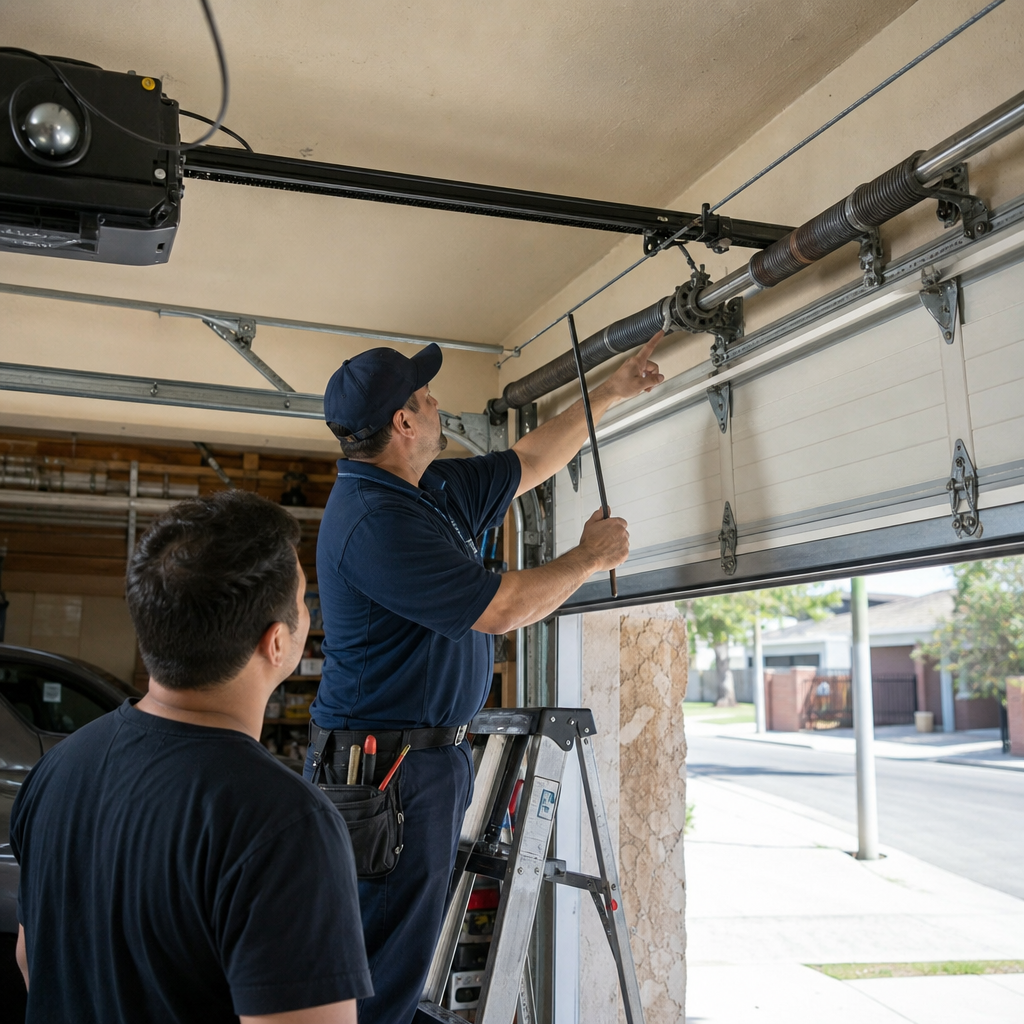
Why Your Garage Door Reverses Before It Closes — and What’s Actually Causing It in Los Angeles
A garage door that reverses before it fully closes is almost always responding to one of three things: misaligned or dirty safety sensors, incorrect close-force settings on the opener, or a physical obstruction in the track. Most of the time it’s fixable the same day. If yours is doing this right now and you’d rather skip the diagnosis, call (844) 747-0953 — Thomas takes the call and handles the work himself.

The Short Answer Most Sites Skip
Your opener has two ways it decides to reverse: an optical safety sensor system near the floor and a built-in resistance sensor that monitors motor load. When either one trips — whether it saw something real or got a false signal — the door goes back up. That’s by design. The problem is figuring out which sensor is lying to you, and why.
After 20 years working on garage doors across Los Angeles — from alley-access detached garages in Koreatown to newer builds out toward Encino — Thomas Hernandez has diagnosed this specific complaint hundreds of times. The cause breaks down roughly like this:
- Misaligned or dirty photo-eye sensors — by far the most common trigger
- Close-limit or down-force settings set too sensitive — common after a power surge or opener reset
- Something in the track — debris, a bent section, or a roller that’s come off
- A worn or broken spring creating uneven tension — the opener reads resistance and gives up
- Post-seismic track racking — specific to Los Angeles, explained below
Common Scenarios We See Specifically in Los Angeles
Los Angeles has a few conditions that make this problem show up in ways you won’t read about on a generic garage door site.
The sensor problem in older South LA and Koreatown bungalows
A significant portion of the housing stock in South LA, Watts, and Koreatown consists of 1920s–1950s bungalows with detached, single-car garages accessed from rear alleys. These garages were never designed for modern sectional doors — the openings are narrow (typically 8 to 9 feet), the framing is original wood, and the floor-level photo-eye sensors that every post-1993 opener requires are often mounted on brackets that have shifted over decades of ground movement and alley traffic vibration. When a bracket gets knocked even slightly out of alignment, the sensor’s LED changes from solid to blinking — and the door reverses every time.
Before calling anyone, check the sensor LEDs yourself. On a LiftMaster or Chamberlain opener, one sensor glows amber (the transmitter) and one glows green (the receiver). If the green one is blinking or off, the beam is broken or the units are misaligned. Wipe the lenses with a dry cloth — LA’s year-round UV and dust load coats those lenses faster than you’d expect — and then gently adjust the receiver bracket until the green light holds steady.
If that doesn’t hold, the bracket mount itself may be loose in rotted wood framing, which is a common finding in these older detached garages. That’s when a service call makes sense.
When LA’s heat cycles are the real culprit
Unlike markets with cold winters, Los Angeles has no freeze-thaw cycle. What it does have is intense heat cycling — metal hardware that bakes in the sun all day and cools overnight, every day of the year. Over time, this warps track sections, causes rollers to wear unevenly, and changes spring tension calibration. A Genie or Raynor door that closed fine in December may start reversing in July simply because the track has crept slightly out of alignment as the metal expanded and contracted through months of 90°F days.
This is also why roller replacement comes up more often in Los Angeles than you’d expect in a mild climate — heat-cycled nylon rollers develop flat spots that create resistance spikes the opener interprets as a blockage. Roller replacement in Los Angeles typically runs $130–$260.
Post-earthquake track racking
Los Angeles sits on an active seismic zone, and even moderate quakes — the kind that rattle dishes but don’t make the news — can rack wood-framed door headers out of square. When the header shifts, the vertical tracks shift with it, and the door binds partway down. The opener’s resistance sensor trips, and the door reverses. This is a genuinely LA-specific failure mode. If your door started reversing shortly after a local tremor, track realignment is the likely fix. In Los Angeles, track realignment runs $140–$285. California also mandates horizontal seismic bracing kits on new garage door installations in high-seismic zones — a code requirement that comes up on every new install we do, and one that technicians in most other states never encounter.
What Each Fix Actually Costs in Los Angeles
Depending on what’s causing the reversal, here’s what you’re realistically looking at in the Los Angeles market:
| Root Cause | Repair Type | Typical Cost Range |
|---|---|---|
| Misaligned/dirty sensors | Sensor adjustment | Included in most service calls |
| Opener limit/force settings | Opener repair/recalibration | $140–$380 |
| Worn or damaged rollers | Roller replacement | $130–$260 |
| Bent or racked track | Track realignment | $140–$285 |
| Broken or worn spring | Spring repair | $210–$400 |
| Broken cable causing uneven load | Cable repair | $155–$295 |
The overall range for Garage Door Repair in Los Angeles runs $175–$710, depending on what’s actually wrong. We don’t push the higher end unless the hardware genuinely requires it — twenty years of doing this work means Thomas can tell the difference between a $50 adjustment and a part that actually needs to come off the door.
A note on springs specifically: torsion springs sit under significant mechanical tension and can cause serious injury if mishandled. If a broken spring is what’s triggering the reversal, that’s not a DIY fix. Call a trained technician.
A Step-by-Step Way to Narrow Down the Cause Yourself
- Check the sensor LEDs first. Both sensors near the floor should show steady lights. A blinking or dark receiver (usually the green one on LiftMaster/Chamberlain systems) means the photo-eye beam is interrupted or misaligned. Clean the lenses and realign before calling anyone.
- Clear the track path visually. Walk the length of both vertical tracks and look for debris, a roller that’s jumped its track, or any visible bending. Alley-access garages in Los Angeles occasionally collect blown-in debris that settles near the bottom track bracket.
- Manually close the door. Disconnect the opener (pull the red emergency cord) and lower the door by hand. If it moves smoothly and stays down, the issue is in the opener’s settings or sensors — not the mechanical hardware. If it binds or feels heavy on one side, you likely have a track, spring, or cable issue.
- Check the opener’s force settings. Consult your opener manual for the down-force adjustment. On most LiftMaster and Chamberlain units, this is a dial or digital menu item. If it’s been reset or bumped, a small adjustment often solves the reversal immediately.
- If it still reverses after steps 1–4, the root cause is mechanical — worn spring, damaged cable, or racked track. At that point, a service call is the right move. For Garage Door Repair that covers all of these, we’re a straightforward call away.
FAQs: What Los Angeles Homeowners Ask About Reversing Garage Doors
Your garage door goes back up after hitting the floor because the down-limit or close-force setting on the opener is calibrated incorrectly — it interprets the resistance of the door contacting the floor as an obstruction and reverses to prevent damage. This is one of the easiest fixes: a small adjustment to the limit screw or force setting on your opener usually resolves it within minutes. Call (844) 747-0953 for a free estimate if you’d rather have it confirmed on-site.
Yes — dirty or misaligned photo-eye sensors are the single most common reason a garage door reverses before closing. In Los Angeles, the combination of year-round dust, UV haze, and vibration from alley traffic makes sensor fouling more frequent than in most markets. Wipe both lenses clean and verify the indicator lights are steady before assuming you need a repair.
Fixing a reversing garage door in Los Angeles costs anywhere from a no-charge sensor alignment (included in most service visits) up to $400 if a broken spring is causing the opener to detect excess resistance. The most common repairs — sensor adjustment, opener recalibration, or roller replacement — fall in the $130–$380 range. Call (844) 747-0953 and we’ll give you a straight answer on cost before anything gets touched.
Yes, and in Los Angeles this comes up more than most people realize. Even a moderate tremor can rack the wood-framed header above an older garage door opening, pulling the vertical tracks slightly out of plumb. The door binds mid-travel, the opener’s resistance sensor trips, and the door reverses. Track realignment in Los Angeles typically runs $140–$285, and if your door started reversing within a few days of a local quake, that’s the first thing worth checking.
Ready to Stop Guessing?
If you’ve run through the steps above and the door is still reversing, the fix is usually straightforward once someone looks at the actual hardware. “Twenty years in LA doors. I’ve seen it break every way possible — let’s just fix it right.” Thomas Hernandez is the one who shows up, diagnoses it, and handles it — no subcontractors, no upsell scripts. Call (844) 747-0953 for a free, no-pressure estimate anywhere in Los Angeles, including the 90050–90053 ZIP corridor.
Written by Thomas Hernandez, Owner & Lead Technician at Titan Garage Door Service Los Angeles, serving Los Angeles, CA.